
We have applied some changes to ARIA and are monitoring stability, but you can continue to work as normal. We appreciate your understanding.
 Instruct
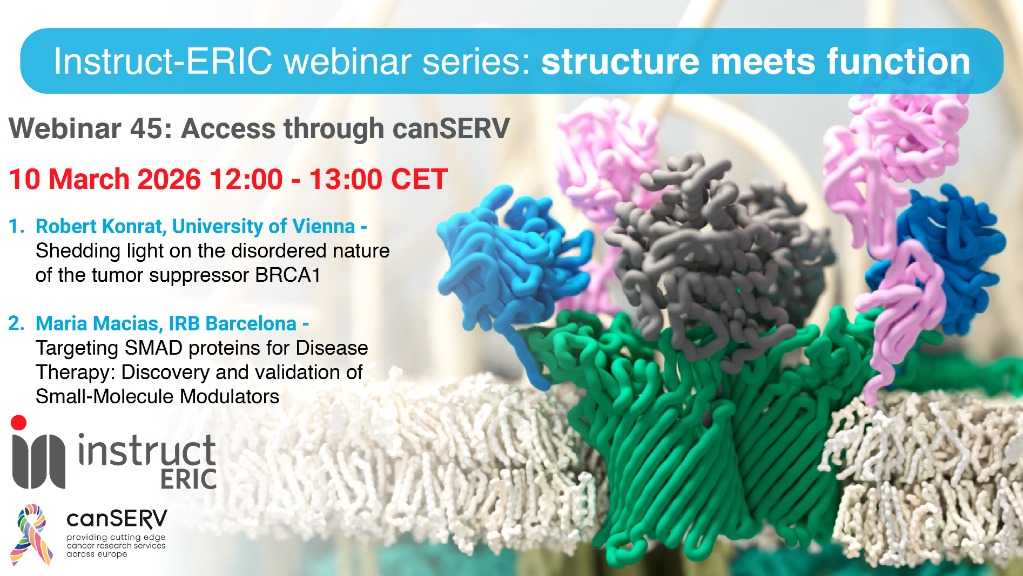
The latest webinar in the Instruct-ERIC Structure Meets Function series this month includes speakers who have accessed cutting-edge structural biology services through Instruct. The webinar series offers an insight into the very cutting edge of structural biology research, utilising the latest techniques available through Instruct-ERIC facilities and centres.
On 10 February, the webinar will feature speakers who have utilised several aspects of Instruct's service offering through the canSERV project. Robert Konrat of the University of Vienna will outline their work utilising NMR technologies at CERM/CIRMMP in Italy, followed by Maria Macias of IRB Barcelona who has accessed EMBL Hamburg through Instruct and canSERV.
The canSERV project provided funding for access provision, focusing on cancer and related research. Calls from canSERV have now ended - structural biology researchers can still receive funding for access through Instruct here.
Register for the webinar here.
Speaker: Robert Konrat
Institution: University of Vienna
Title: Shedding light on the disordered nature of the tumor suppressor BRCA1
Abstract: Intrinsically disordered proteins (IDPs) as well as intrinsically disordered regions (IDRs) play a crucial role in multiple cellular pathways. Due to their highly flexible nature, they cannot be investigated with methods like X-ray crystallography or cryo-EM. Thus, nuclear magnetic resonance (NMR) spectroscopy provides a unique tool to study these proteins. The focus of this project is the tumor suppressor BRCA1 (breast cancer associated protein 1), which was shown to play a major role in both familial breast and ovarian cancer formation. Although there is some structural data available on the folded termini of this protein, the intrinsically disordered core, which makes up roughly 80% of the protein remains mostly uncharacterized.
Here, we show the successful completion of the NMR signal assignment as the basis for subsequent detailed analysis of its interaction with authentic binding partners relevant for transcription regulation and DNA repair. Preliminary results already suggest that novel insights into the complex interplay of different BRCA1 binding events can be obtained with potential impact for novel strategies to target pathologies caused through e.g. mutations.
Speaker: Maria Macias
Institution: IRB Barcelona
Title: Targeting SMAD proteins for Disease Therapy: Discovery and validation of Small-Molecule Modulators